Crisis management
Crises are an unavoidable part of running any company or organisation.
They are often difficult to predict and can have a significant impact.
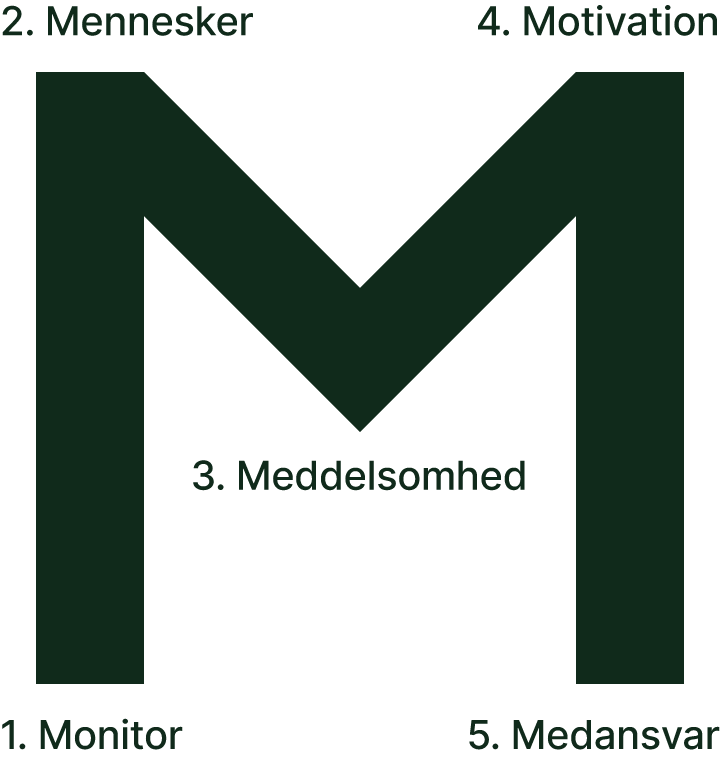
Our primary objective is to help you prevent crises through ongoing counselling. Once a crisis has occurred, we assist you with systematic management. We specialise in the M-Model (in Danish), a systematic approach to crisis management and communication.
Crisis management with the five M's Model (in Danish)
1. Monitoring (Monitorering)
When Influenter supports crisis management, the first step is to create an overview of the crisis’s substance, map potential risks and stakeholders involved. What risks are there, and who are the collaborators and adversaries?
In a fast-moving public sphere, where information is shared instantly by many, it’s vital to set an agenda straight away. As a pivotal figure in crisis management, you must communicate quickly to shape the narrative. Influenter can help with overviews and initial public statements.
2. People (Mennesker)
During a crisis, communication must be consistent and prioritised. It will usually be focused on:
- Caring for people. If there are direct victims or employees to be laid off, this should be the top priority.
- Minimising environmental impacts. If there is a risk to the environment this should be addressed.
- Sharing key information. All relevant details should be communicated in a structured framework.
- Economic consequences: While not always relevant, if it is important, it should be at the bottom of the priority list.
Our company can provide support in establishing this message hierarchy, as well as producing the necessary written material and offering media training.
3. Communication (Meddelsomhed)
As the center of the crisis, you must appear willing to keep the public informed about the course of the crisis and its resolution. A company that hides its head during a crisis damages its brand and potentially its business. Therefore, openness and the signal of a willingness to communicate on an informed basis are crucial.
4. Motivation (Motivation)
In addition to demonstrating a willingness to communicate clearly throughout the crisis, it is essential that the public – citizens, the press and politicians – experience that you have a sincere desire to resolve the crisis.
5. Shared responsibility (Medansvar)
Finally, it is important that in the early stages of the crisis, you never assign blame. Initially, you must assume shared responsibility for the emergence of the crisis, but it can be counterproductive to come out too early and assume blame. The message should be that you assume shared responsibility for mapping out the substance of the crisis.